
Hello all,
Let’s first very quickly recapitulate Quantpedia Premium development in the previous month: Ten new Quantpedia Premium strategies have been added to our database, and ten new related research papers have been included in existing Premium strategies during the last month. Additionally, we have produced 11 new backtests written in QuantConnect code. Our database currently contains over 440 strategies with out-of-sample backtests/codes.
And now, let’s move to our Quantpedia Pro subscription offering news.
Our clients often mentioned one particular report as something they would love to see in the Quantpedia Pro – it’s the Markowitz Portfolio Optimization, and we are really happy that we can announce that it’s ready 🙂
What does it offer? It allows you to see classical risk vs. return charts that display how your selected Model Portfolio performs in comparison to other optimal portfolios built from the same individual components. You can review Tangency portfolio – the so-called optimal portfolio that realizes the highest possible Sharpe ratio, Minimum Variance portfolio – portfolio with the lowest risk and Maximum Return portfolio, the Efficient Frontier (a hyperbola representing portfolios with all the different combinations of assets that result into efficient portfolios), and Capital Market Line – that represents a portfolios of different combinations of a risk-free asset and a Tangency Portfolio. Additionally, our report shows portfolio weights along the Efficient Frontier.
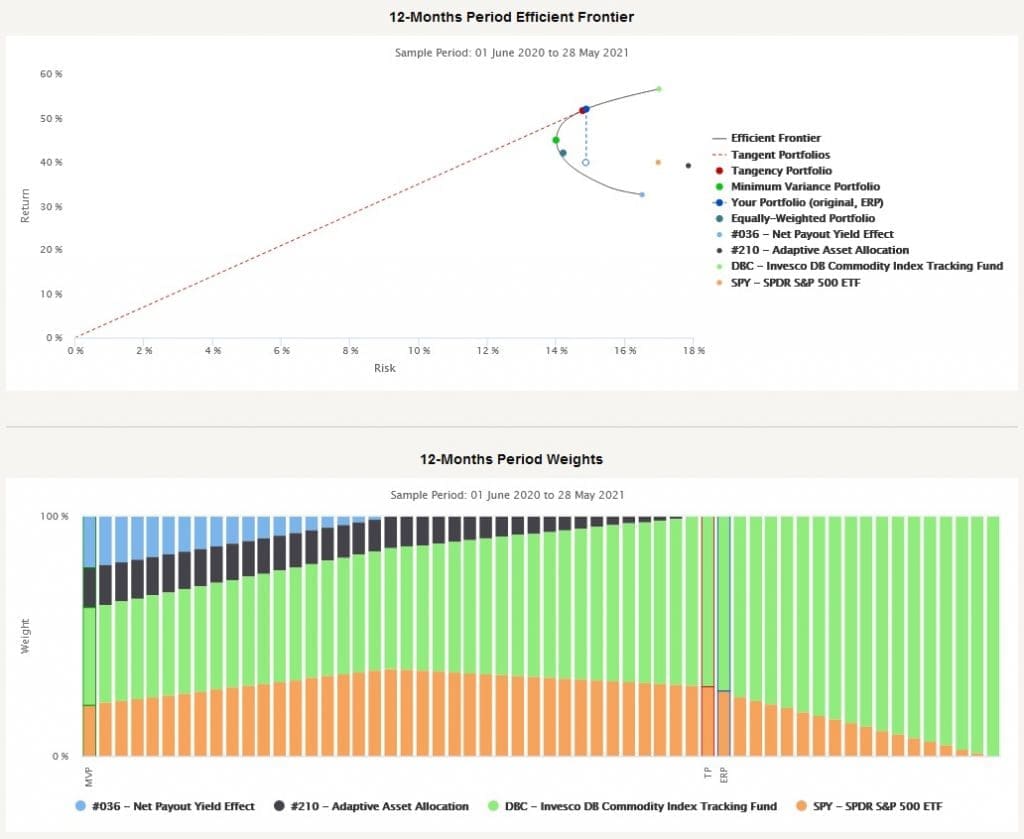
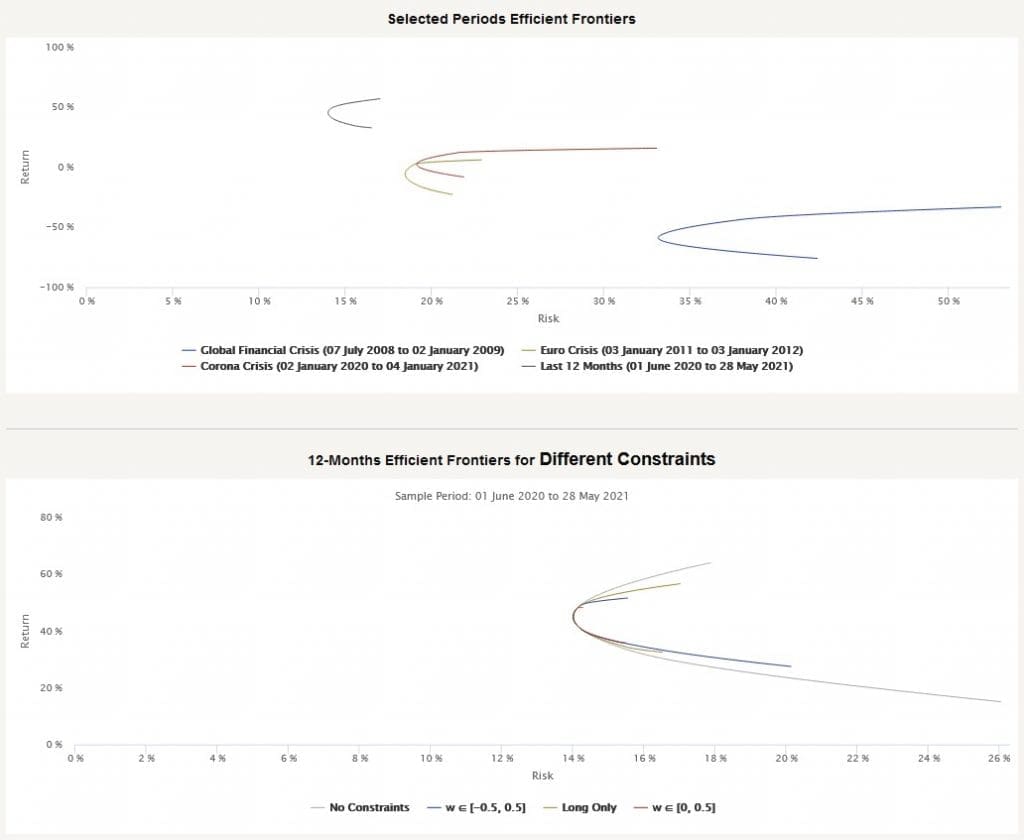
The Markowitz Portfolio Optimization report charts are displayed for various periods (actual 12-months period, the longest available period, and periods that contain various significant market drawdowns) and for various constraints (long-only portfolio, 0% to 50% weights, -50 to 50% weights and no constraints). We will again publish a short article about all of the math & methods behind this report in a few days.
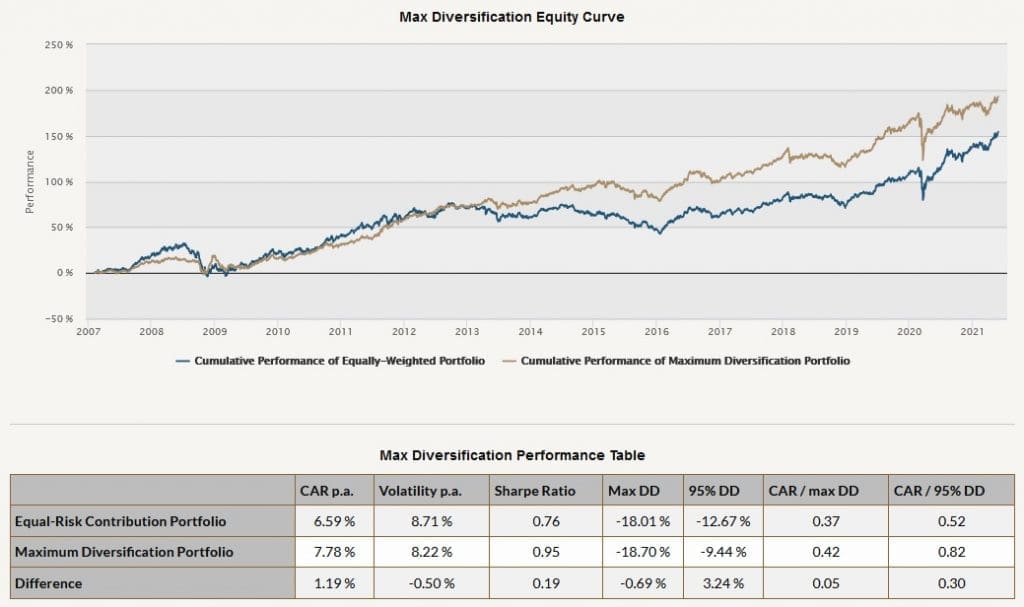
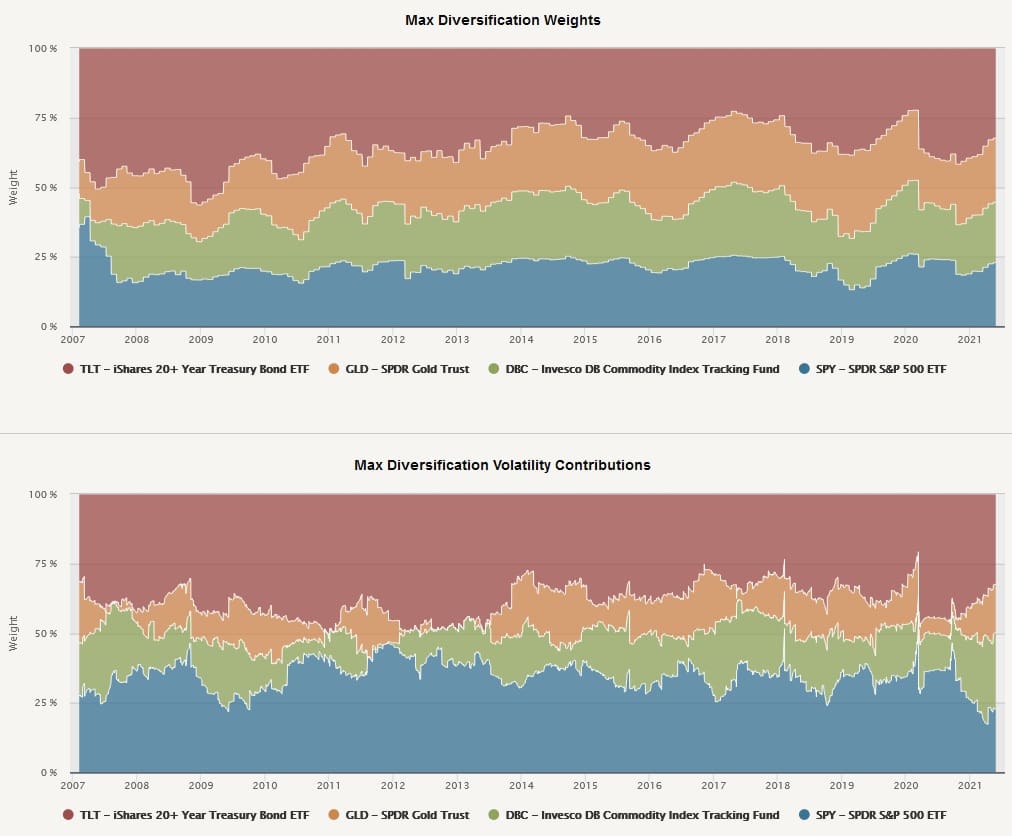
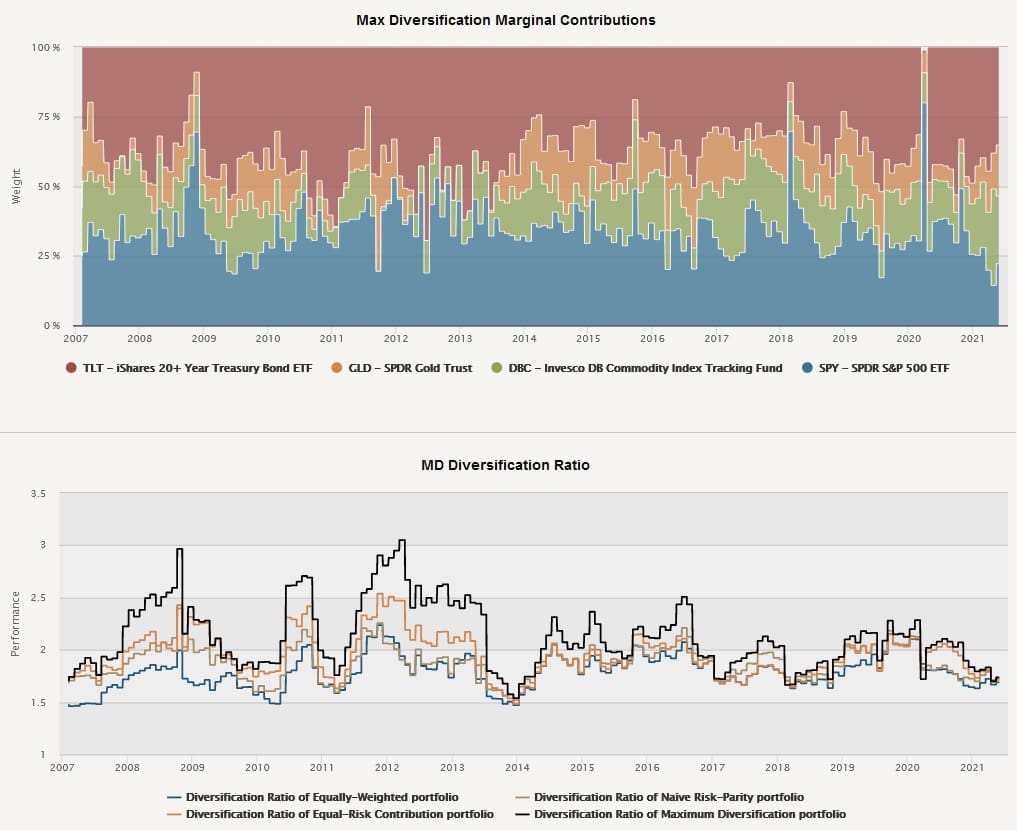
Plus, two new additional Quantpedia Pro reports are again related to the Risk Parity portfolio allocation strategies. In April, we implemented the Naive Risk Parity method and May was dedicated to the implementation of Equal Risk Contribution y Maximum Diversification methods. All Risk Parity methods contain similar charts (equity curves, performance table, risk contributions, volatility contributions), plus we have added two new charts – marginal risk contribution and diversification ratio over time.
And finally, four new blog posts that you may find interesting have been published on our Quantpedia blog in the previous month:
Measuring Financial Investors Presence in Commodities
Autores: Zeno Adams, Solene Collot and Davide Rossi
Titles: Measuring Financial Investor Presence through Term Structure Anomalies
Pump and Dump in Cryptocurrencies
Autores: Anirudh Dhawan and Tālis J. Putniņš & Tao Li, Donghwa Shin and Baolian Wang & Jiahua Xu and Benjamin Livshits
Título: A New Wolf in Town? Pump-and-Dump Manipulation in Cryptocurrency Markets & Cryptocurrency Pump-and-Dump Schemes & The Anatomy of a Cryptocurrency Pump-and-Dump Scheme
ESG Incidents and Shareholder Value
Author: Simon Glossner
Título: ESG Incidents and Shareholder Value
Risk Parity Asset Allocation
Author: Daniela Hanicova
Título: Risk Parity Asset Allocation
Stay safe …
Radovan Vojtko
CEO & Head of Research
¿Buscas más estrategias para leer? Suscríbete a nuestro boletín informativo o visite nuestra Blog o Evaluador.
¿Quieres saber más sobre el servicio Quantpedia Premium? Consulta Cómo funciona Quantpedia, nuestra misión y Oferta de precios premium.
¿Quieres saber más sobre el servicio Quantpedia Pro? Compruébalo descripción, mirar videos, revisar capacidades de generación de informes y visite nuestro oferta de precios.
¿Buscas datos históricos o plataformas de backtesting? Consulta nuestra lista de Descuentos en Algo Trading.
¿Te gustaría tener acceso gratuito a? nuestros servicios? Entonces, Abre una cuenta con Lightspeed. y disfrute de un año de Quantpedia Premium sin costo alguno.
O síguenos en:
Facebook Grupo, Facebook Página, Gorjeo, LinkedIn, Medio o YouTube