
Quantpedia is The Encyclopedia of Quantitative Trading Strategies
We've already analyzed tens of thousands of financial research papers and identified more than 1000 attractive trading systems together with thundreds of related academic papers.
- Unlock Screener & 300+ Advanced Charts
- Browse 1000+ uncommon trading strategy ideas
- Get new strategies on bi-weekly basis
- Explore 2000+ academic research papers
- View 800+ out-of-sample backtests
- Design multi-factor multi-asset portfolios
Sports betting is the favorite entertainment of many people. However, bookmakers are reportedly more skilled at predicting game outcomes than bettors, and betting markets are therefore extraordinarily efficient. Betting shops' wide spreads are an additional obstacle. This means that it is exceptionally hard to beat the house in this game.
But one remarkable academic study shows that there are inefficiencies in publicly listed soccer clubs' stocks, which can be exploited. Investors systematically overvalue stocks before important matches as they believe in positive outcomes. Teams often draw or lose a game, and stocks incur negative returns. A complicated variant of this strategy (not stated in this version, but theoretically feasible) could be created by using booking shops to hedge equity market transactions.
Fundamental reason
The academic paper postulates that an important reason for the stock market's apparent inefficient response to soccer game results is the systematic bias in investors' beliefs about the probability distribution of match outcomes. Bookmaker odds are compiled by a small group of experts and do not reflect investors' subjective beliefs, while equity prices do so.
Get Premium Strategy Ideas & Pro Reporting
- Unlock Screener & 300+ Advanced Charts
- Browse 1000+ unique strategies
- Get new strategies on bi-weekly basis
- Explore 2000+ academic research papers
- View 800+ out-of-sample backtests
- Design multi-factor multi-asset portfolios
Strategy profile
- Market factors
- Equities
- Financial instruments
- Stocks
- Regions
- Europe
- Number of traded instruments
- 20
estimated number of stocks used for trading, actual number of stocks could differ as not all soccer clubs mentioned in the study are still listed on market and/or are liquid
- Complexity
- Moderate
- Rebalancing period
- Daily
- Confidence in anomaly's validity
- Moderate
- Transaction costs
- Mentioned
Reported stock-return results are not adjusted for transaction costs. Section 6.2 mentions betting-market frictions only: bookmaker odds imply an average 8% transaction cost (the overround), while betting-exchange fees average about 3%, so deviations up to roughly 5% may not be arbitraged; these costs concern betting contracts and are not deducted from the club-stock event-study returns.
- Robustness checks
- Assessed
The primary post-match-return finding is tested under alternative implementations: the authors state that results also hold using raw rather than abnormal returns and when estimating the market model over the full sample rather than annually (Section 5.1); they state all results are robust to excluding group-stage matches (Section 3). For the central expectations-adjusted tests, Table 9 repeats results in the matched 203-game sample with both betting-exchange and bookmaker data; the subjective-probability restrictions remain unrejected while bookmaker-based restrictions are rejected. They also state that using Betfair data alone does not qualitatively alter results (Section 6.2).
Source-paper performance
- Backtest period
- 2000 – 2006
- Indicative performance
- 42%
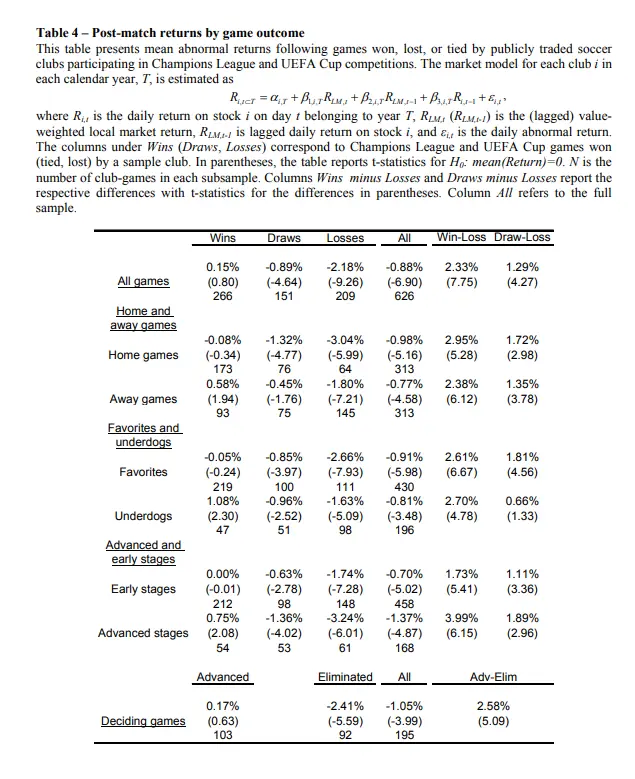
per annum, estimated return based on data from table 4 - annualized (geometrically) daily return 0,88%, estimated 40 days in a year when matches are played
- Estimated volatility
- 50%
estimated from t-value from table 4
- Maximum drawdown
- Not reported
not stated
- Sharpe ratio
- 0.76
Simple trading strategy
The investment universe consists of liquid soccer clubs' stocks that are publicly traded. The investor then sells short stocks of clubs that play UEFA Championship matches (or other important matches) at the end of the business day before the match. Stocks are held for one day, and the portfolio of stocks is equally weighted (if there are multiple clubs with matches that day).
Hedge for stocks during bear markets
Yes – The short-selling strategy is a natural hedge/diversification to equity market factor during bear markets.
Out-of-sample strategy implementation in QuantConnect (chart, statistics & code)
Related video
Related picture
Source paper
Bernile, Lyandres: Understanding Investor Sentiment: The Case of Soccer
Abstract: We examine whether investors' biased ex-ante beliefs regarding probability distributions of future event outcomes are partially responsible for instances of stock market's inefficient responses to resolutions of uncertainty. We use a sample of publicly traded European soccer clubs and analyze their returns around important matches. Using a novel proxy for investors' expectations based on contracts traded on betting exchanges (prediction markets), we find that within our sample investor sentiment is attributable in part to a systematic bias in investors' ex-ante expectations. Investors are overly optimistic about their teams' prospects ex-ante and, on average, end up disappointed ex-post, leading to negative post-game abnormal returns. Our evidence may have important implications for firms' investment decisions and corporate control transactions.